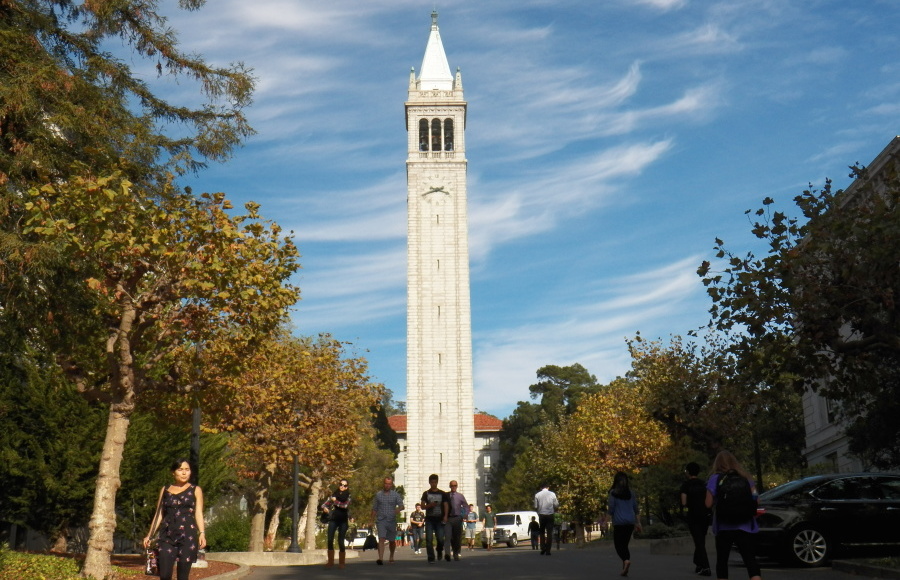
I was quite excited to get notified by the admissions that I was accepted to UC Berkeley, the #1 stressed out public university in the US. Although part of me wished for a better university, I was asking too much. Of course, similar to other then-high-school students, I was nervous about the things that might happen in this university. I have heard people saying that it has a stressing environment, or that it has very poor security (one of the reasons my mom argued to persuade me to attend UC San Diego instead), or that the bureaucracy can seem daunting and inefficient at times. Truth be told, UC Berkeley indeed has a very stressing environment, even mentally breaking in extreme cases; the university does have a bad track record when it comes to campus security; and the bureaucracy is slow, though I haven’t had many opportunities to experience this inefficiency first-hand.
Despite those downsides of attending UC Berkeley, after a semester, I found myself still alive! I have made some friends there; I have only been slightly stressed out by classes; and I finally experienced the college experience with not much to regret.
Before School Started
Please do research. You will regret this if you don’t. Berkeley is merciless when it comes to competition.
Yun-Fan Wu (Myself)
Clubs
It’s important to understand how UC Berkeley works because since it’s a huge university with a large student body, a lot of things will be relatively competitive. For example, clubs and Greek Life are sometimes extremely hard to get in. My first-year roommate applied to, if I remember correctly, 7 consulting clubs, and only got into 1. Each consulting club application requires a good chunk of effort and time. It kind of reminds me of college applications all over again, which isn’t the best experience when I’m busy proofreading my essays. And to make things worse, each club application might ask for different essays, which means you need to write multiple 200-400-word essays during rush season, typically lasting for a few weeks. Of course, there are perks when you are in a consulting club. You can establish connections; you can start constructing your business portfolio; and you can make friends with club members during socials! Does the advantages outweigh the competitiveness? It’s up to individual interpretation. Some people are willing to write those essays in exchange for connection, while other people (like me) chose to join less competitive clubs, which, in turn, won’t give me much connection.
Classes
Choosing your classes is quite a laborious one. First of all, you need to at least know the required classes for graduation. There are three big requirements you need to meet.
- University Requirements
- College Requirements
- Major Requirements
Research those requirements, and come up with a plan to distribute them among the 4 years (or 3, or 5, or 6). When it comes to course registration, it’s a competition of both luck and speed. It’s a competition of luck because due to the large student body, the enrollment website will crash if all of the students enroll at the same time. So, the university will randomly assign a starting time for enrollment for students. For example, my friend got a 9:00 starting time while I got a 14:40 starting time, which, for me, is a huge disadvantage. In this case, it’s now a competition of speed. In order to make sure the 4-year plan doesn’t get messed up very badly, I need to readjust my courses. However, I can’t change my major requirements. As a result, I look at college requirements and university requirements and try to find any classes that are still available (those requirements often refer to a group of classes so it offers a lot of flexibility).
A lot of people complain they didn’t get the classes they wanted, which is a normal situation we will go through nearly every semester. Keep in mind that you must have a list of classes that you can and want to take, a list of classes that offers flexibility when you got a late enrollment starting time, and websites that help you with those such as classes.berkeley.edu and berkeleytime.com. Those are extremely helpful tools.
Connections
It’s essential for you to know what is going on. Berkeley is a huge university. As a result, you have to look for helpful resources by yourself and be on the lookout for information from the university campus. They will send emails to update you the situation and what you will need to do, which is already useful enough. Be sure to also add the university on Facebook. Clubs and potential renters will post information regarding applications there. Also, if there is a student-run discord, you can also join. I joined the Cal 25′ Server and made a lot of friends there. I even established myself as the Rejuvenator who posts updates every night since April 2020. It’s a very unique experience, especially for me who was using Discord for the very first time. The people on the server are very friendly. Although there are a bit of ups and downs, I still enjoyed a lot being in the server. Eventually, those online acquaintances became friends in real life. I met those interesting people and had fun with them!
What to Expect
Lowering your expectations will prove to be useful. The housing situation in Berkeley is still in a state of “crisis”. I live in Unit 2, one of the many university dorms on campus, and the room is very small. I wouldn’t recommend studying in the dorms because of the tiny space that you will have in a standard dorm room.
The food on campus is not good, but not completely inedible. Despite popular belief that the food on campus is literally garbage, it really is not. The food is completely edible, and the fact that I’m still alive proves it. You just need to get used to it. A complaint I have to make, though, is that the rice is very bad. It’s either under-cooked or overcooked. Of course, there are a lot of alternative options for dining if you really can’t eat food from the dining halls. Restaurants are everywhere around campus. You can download Snackpass (a mobile app) and order dishes online from surrounding restaurants. This would be very useful if you go for a regular meal plan, which only offers 12 meals per week.
Security is bad. There are homeless people everywhere, and things happen all the time. I remember before I arrived on campus, there was an arson right in front of my dorm building. Throughout the semester, there are multiple cases of aggravated assaults, burglaries, and thefts. Don’t go out at night. If you have to, never walk alone. There are resources for your own safety out there. Don’t risk your personal safety out there. However, please don’t be scared by this bad track record of security. If you go out during daytime in non-suspicious places, and don’t purposely aggravate people, you’ll be fine.
There are a lot of resources on campus ranging from safety, health, to academics. However, they won’t always remind you of those extremely useful resources. You need to actively utilize those resources: go to the Student Learning Center (SLC) to get tutoring; go to the Open Computing Facility (OCF) for free printing; go to PATH or the Tang Center for mental and physical healthcare. Communication and being active in participating is important. Those resources won’t find you; you need to find them yourself.
Academics
Always have the mentality that you will not have an easy time here. UC Berkeley is dubbed “Most Stressful Public University” for a reason.
I won’t go into much detail on how courses work because each course has its own syllabus. However, there is a general pattern for survival.
- You need to know exactly what you are doing and what you will do.
- Make sure you have a schedule to follow. Also make sure the schedule is flexible.
- Utilize opportunities where you can ask questions. It helps you and others.
- Don’t spend time on too many parties. You’re here to study, not to relax.
Let’s elaborate further.
For the first point, it is extremely important to understand your current situation. For me, every day, assignments are handed out and graded; quizzes are carried out and graded; lectures are in session; and clubs are operating. There are a lot of things happening every day even though you might not have any classes at all on a particular day. Instead of using that day to take a break, take a step back, and think about where you currently are in terms of academics and grades: Am I doing well in class? If so, how can I maintain this? If not, how can I improve myself?
After understanding your situation, quickly whip out a schedule: I will finish these assignments and those projects today. I’ll also review these concepts. My experience tells me that it will be better if you can have a schedule that is relatively full because it looks feasible such that you won’t be intimidated by the workload. Another reason is that you’ll probably just finish 80% of the schedule anyways, so make it relatively full.
Discussions are important because it’s where you can review and discuss concepts explained in lectures in a more personal way. You can have “hands-on” experience on those concepts. Those direct “contact” with those concepts will definitely strengthen your understanding. Of course, in addition to discussions, office hours and asking questions via email are also very good methods of concept understanding.
Last but not least, you need to correct your mentality about university. University is not about relaxing and partying. We are here to study; we are here to study more; we are here to expand our knowledge. A lot of people seemed to misunderstand the purpose of being in university and thus suffered a lot on their grades. Do not fight for a passing grade; fight for a better grade so that you will at least try. Do not spend most of your time on clubs, parties, or other activities. Those are events that you participate when you have time left. I’m not discouraging extracurricular activities though because I personally am in the University Symphony Orchestra, the Intermission Orchestra, and the Taiwanese Student Association. I participated in those activities because I am sure that I have time for those activities without negatively affecting my grade.
Having a strong mental health is important when you are faced with stress, especially in UC Berkeley. Find your sweet spot regarding how many units you’re taking (I took 19 units for the first semester and 20 for the second semester). Some people are fine with 14 units while others might long for a more challenging schedule (such as 23 units). Although grades are important in university, your mental health is more important. However, rather than constantly taking care of yourself, train yourself. Those stress, when being absorbed in correct ways, can become a very useful tool for personal growth and maturity. You learn how to manage stress and huge workloads under a short time period. You learn how to efficiently communicate others about your needs and expectations. You learn how to respect others without making yourself a yes-person. The stress in UC Berkeley can be daunting at first, but if you survive the test, the knowledge you gain in the end is very rewarding.
Conclusion
Similar to almost any daunting task, if you are prepared for it, it will be easier for you to finish the task. UC Berkeley is not an exception. If you are prepared for the academic pressure, you can blossom in this environment.
 Yun-Fan Wu