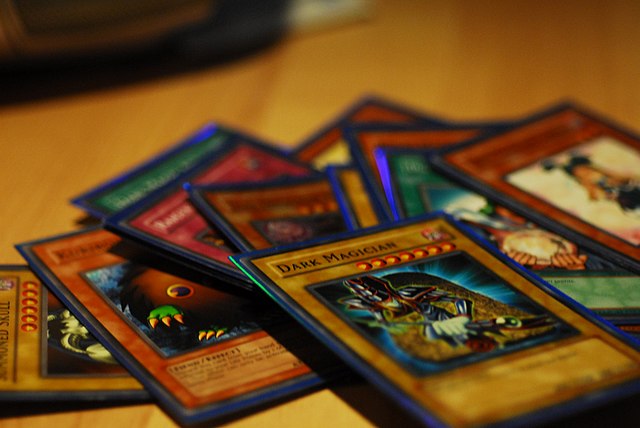
Thanks to one of my friends in university, I just got into the Yu-Gi-Oh Community. For those who don’t know (including myself a few days ago), Yu-Gi-Oh (YGO) is a turn-based strategy card game. It’s similar to hearthstone in terms of gameplay but varies a lot when we focus onto their respective details, but it would be too much work to actually analyze either game, for both franchises already have a very well-developed, in-depth gaming system.
I remember when I was in my grandparents’ house, on the second floor, there were some cards hidden in closets. I used to wonder what those cards were, and I would just assume them as Pokemon cards. Now that I got into the YGO community, I realized those cards were actually YGO ones, and belong to my younger cousin who used to live there. And one realization leads to another, I also realized that he used to collect those cards, and tried to explain those cards to me. Unfortunately, I wasn’t much of a card-collector or a YGO fan, so I didn’t pay much attention to those. The only takeaway I took with me is that YGO is just complicated.
And complicated it really is! After my friend (we’ll just call him Brandon from now on) introduced me to this game, I was a bit hesitant, since, after all, I’m still an undergraduate studying in the #1 stressed university in the US. Nevertheless, he persuaded me to get into this game in the end, and he did it quite easily. He just told me that I could use a Dragonmaid Deck (A deck of cards consisting of dragonmaids). I was instantly sold.
After my first match in the solo campaign, I have to say, YGO is extremely complicated and requires a lot of effort if one really wants to get good in this game. There are several phases with several subphases within each phase, and each card has different effects that activate at different phases. There are countless examples to demonstrate the complexity of the YGO universe. For example, let’s just use the Dragonmaid deck. Suppose I summon a Dragonmaid onto the battlefield, I can activate the Dragonmaid effect, which puts a dragon from the deck to the second deck. And when I’m at the battle phase, I can activate the Dragonmaid effect again, which returns itself to my hand and summons the dragon in the second deck. And at the end of the battle, the dragon on the battlefield can be activated, which sends itself back to the second deck and summons the original Dragonmaid on my hand.
If you are already dizzy reading this sequence of actions, you’re just part of the many people who, too, suffered this wave of confusion (and many more to come) when first playing YGO. There are many rules that are not explicitly stated and requires a lot of analysis and logic to work out the situation. I can imagine a new player, curious about YGO, and played its first game. When the player sees the description on the card, he would just quit because there are just too many words. And another huge inconvenience for English-speaking players is that the English version of card descriptions are filled with inconsistencies, as opposed to the Japanese version, which states a lot of elements clearly in a few lines of characters.
For me, I really do appreciate the existence of Brandon, who carried me along my YGO training ark. And probably under my influence and persuasion, he’s also constructing a Dragonmaid deck (he mainly uses other decks).
Now that I’ve finished my complaints on the difficulty of YGO, I want to discuss the gaming difficulty curves. Some games are very easy to get into, but very hard to master (like basically every academic subject in society); some games are very hard to get into, but very easy to master (since all the hard parts are already conquered at the beginning); some games are just easy all the way; while others are just Dark Souls variants (Dark Souls is a game franchise which puts a lot of emphasis on difficulty and challenges). Nintendo’s Super Mario 3D platformers (64, Sunshine, Galaxy 1 + 2, 3D Land + World + Bowser’s Fury, and Odyssey) mostly did a great job at difficulty management, with a smooth yet unboring curve as the game progresses. While YGO, on the other hand, puts more focus on further expanding card varieties, which inevitably leads to an increase in complexity. Card games are prone to this unstoppable trend of getting more and more complicated because as they add more cards into the whole collection, they need to come up with more unique effects for different cards to keep the game fresh so that they can keep and even expand their player base. As a result, things get more and more complicated, and for those who got on the YGO train a bit late (such as me), I would be quite overwhelmed by the sheer number of cards available at my disposal (and, of course, the inclusion of microtransactions).
The YGO Master Duel game was recently released on Steam (price is free at time of writing). And to be honest, the tutorial wasn’t the best – it just tells you what to do and expects players to blindly follow the directions, which is, obviously, not the best way to make a tutorial. But, I hope that in the future, when they have more time to polish this system, they can make a better tutorial. As far as the complex gaming system, it’s a product of the card game expansion, and I really can’t complain much. However, I do see a good amount of microtransaction intentions in the game.
Although I made a lot of complaints about YGO, I still like this game, because watching myself combo-ing a lot of moves is very satisfying. As much as I like to see myself combo in YGO, I still need to focus on studying, so who knows if I just drop this game entirely because I have too much work to do!
 Yun-Fan Wu
It looks so much like Pokemon which Victor collected and played. They both seem complicated (therefore boring) to me.
LikeLike